
UPI New Rules 2026: MDR to apply on large UPI payments from 15 October - who has to pay
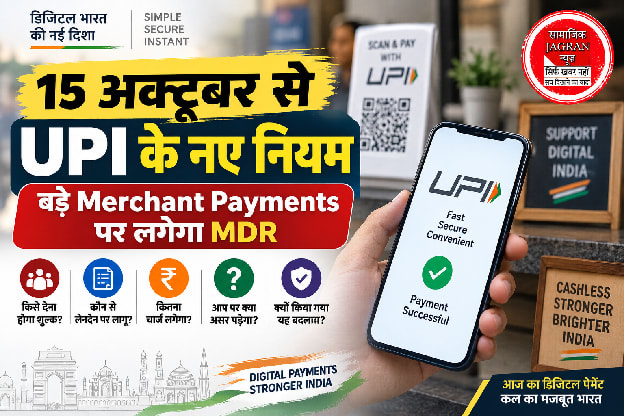
“From 15 October 2026 a 0.4 per cent MDR will apply to some UPI merchant payments above Rs 2,000, charged to the merchant and not the customer. P2P payments and small merchants stay out of it.”
New Delhi: A major change is coming to UPI, India's biggest digital payment channel, from 15 October 2026. Under the new rule, a 0.4 per cent Merchant Discount Rate (MDR) will apply to some UPI merchant payments above Rs 2,000. However, customers will not pay it directly. The charge will be levied on the merchant concerned.
Person-to-person (P2P) UPI payments will not attract any MDR. Small merchants have also been given relief from the new charge. So this is not a fee on all UPI users; it relates mainly to certain large merchant transactions.
What is the new UPI rule?
Under the new arrangement from the National Payments Corporation of India (NPCI), from 15 October a 0.4 per cent MDR will be charged on some Person-to-Merchant (P2M) UPI transactions above Rs 2,000.
The MDR will be capped at Rs 300 for transactions up to Rs 75,000. This means that if a customer pays a merchant Rs 5,000, the MDR at 0.4 per cent will be Rs 20. On a transaction of Rs 50,000 the charge will be Rs 200.
For transactions of Rs 75,000 or more, the maximum MDR will remain Rs 300.
This does not mean that everyone who sends money through UPI will have to pay a fee. Ordinary P2P transactions are outside the scope of this change.
What is MDR?
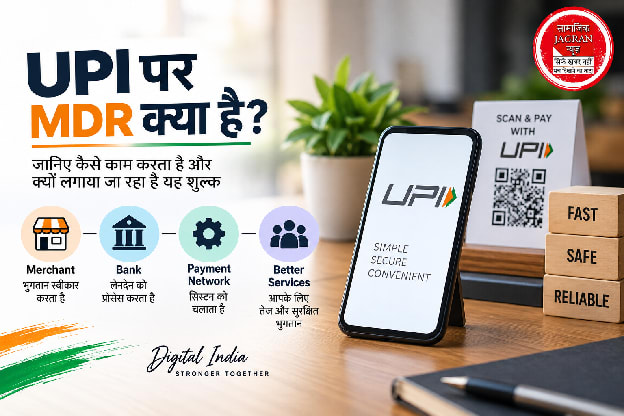
MDR, or Merchant Discount Rate, is the fee charged to a merchant for accepting a digital payment. It is shared among the different participants in the payment ecosystem.
These may include banks, payment service providers and other related entities.
It would therefore not be correct to treat UPI MDR as a UPI charge or tax on the customer. Under the current arrangement, the fee is applied on the merchant side.
Who will have to pay MDR from 15 October?
The new MDR will mainly apply to certain large merchant payments.
In simple terms:
- No MDR on eligible merchant UPI payments up to Rs 2,000.
- A 0.4 per cent MDR on some merchant payments above Rs 2,000.
- The maximum MDR will be Rs 300 on transactions of Rs 75,000 or more.
- No MDR on Person-to-Person (P2P) payments.
- Some small merchants have also been kept out of MDR.
- A separate fee structure will apply to certain specific sectors.
So sending money to a friend, a family member or anyone else through UPI will not be affected by this new rule.
Why has the government imposed MDR on UPI?
UPI has long been run under a Zero-MDR model. The aim was to promote digital payments and encourage as many people and merchants as possible to adopt UPI.
UPI transactions have grown very rapidly in the past few years. Lakhs of crores of rupees are transacted through UPI every month. Along with this, the cost of payment infrastructure, technology, cybersecurity, fraud prevention and customer support has also risen.
For this reason, a limited MDR has been introduced on large merchant payments to make the UPI ecosystem financially sustainable.
One aim of the new arrangement is also to earn some revenue for the payment infrastructure from large transactions, without affecting small and everyday digital payments.
Will ordinary UPI users have to pay more?
For now, under the new rules, the MDR is to be paid by the merchant, not collected directly from the customer.
This means that if a person makes an eligible merchant payment of Rs 5,000, they will not have to pay an extra Rs 20 on top of their UPI transaction.
However, this will be an additional business cost for merchants. How different businesses adjust this extra cost within their margins will depend on their business model.
Some industry representatives have raised concerns that the additional cost could become a challenge for merchants. On the other hand, supporters of the MDR system say that a limited fee on large transactions can help the sustainability of the payment ecosystem.
What relief have small shopkeepers got?
The new rules make provisions to give relief to small merchants.
According to reports, small merchants in the P2PM category, whose UPI collections are within the prescribed limit, will stay outside MDR.
This means an attempt has been made to limit the impact of the new rule on small grocers, local shopkeepers and small businesses.
This can help keep small, everyday UPI payments going on digital channels.
Which services will have a different fee?
The same MDR will not apply to every merchant category.
A separate arrangement has been made for some essential services and sectors. These include categories such as railways, telecom, insurance, fuel, electricity, water and piped natural gas.
A separate flat fee structure applies to eligible payments above Rs 2,000 in these categories.
A different MDR rate has also been set for some capital-market transactions, such as mutual funds and securities-related payments.
UPI AutoPay transactions have also been kept outside this MDR structure.
Understand the new UPI MDR with an example
Suppose a customer makes a UPI payment of Rs 5,000 to an eligible merchant.
0.4% MDR = Rs 20
But this Rs 20 will not be deducted separately from the customer's UPI account. It is a merchant-side charge.
If the transaction is Rs 50,000:
0.4% MDR = Rs 200
And if the transaction is Rs 1 lakh, the usual 0.4 per cent works out to Rs 400, but because of the prescribed maximum cap, the MDR will not exceed Rs 300.
In other words, even for large transactions a maximum limit has been set on MDR.
Why is this change important for UPI?
Over the past few years UPI has become an important part of India's digital payment ecosystem. Its use has grown rapidly, from small shopkeepers to large businesses.
The Zero-MDR arrangement played a role in increasing UPI adoption. The focus of the new rule is to keep small payments and P2P transactions free while recovering part of the cost of the payment ecosystem from large merchant transactions.
However, its real impact will become clear only after 15 October. It will be especially important to see how merchants manage this additional cost in their business and how much it affects digital payment behaviour.
What should ordinary people remember?
The new UPI rule can be understood in simple terms like this:
UPI is not being shut down or made fully paid.
The new MDR will apply only to certain specific merchant transactions. There will be no MDR on person-to-person payments. Small merchants and many everyday small payments will also stay outside this fee.
So from 15 October 2026, UPI users will not have to pay any new charge on every transaction. The change mainly concerns eligible large merchant payments and the fee structure of the payment ecosystem.
Conclusion
The UPI MDR coming into force on 15 October 2026 is an important change in the digital payment system. Under the new arrangement, a 0.4 per cent MDR will be charged on some merchant transactions above Rs 2,000, with a maximum cap of Rs 300.
P2P transactions and many small merchant payments have been kept out of it. The stated aim of the government and the payment ecosystem is to make the UPI infrastructure and related services financially sustainable.
How much real impact the new rule has on merchants, businesses and India's fast-growing digital payment ecosystem will become clear in the coming months.